
Cricket Betting Strategies Guide for IPL Odds & Predictions
Cricket betting has revolutionised how fans engage with the sport, transforming passive viewers into active participants. The Indian Premier League (IPL) stands at the center of this revolution, attracting millions of bettors seeking to capitalise on dynamic odds, unpredictable match outcomes, and diverse betting markets. This comprehensive guide reveals proven cricket betting strategies targeting IPL odds and match predictions, as well as risk management techniques designed to maximise profits while minimising losses.

Table of Contents
Understanding Cricket Betting Fundamentals
Why Cricket Betting is Different from Other Sports
Cricket presents unique betting opportunities that distinguish it from football, basketball, or tennis.
- Match Unpredictability – T20 cricket, lasting just 3–4 hours, sees rapid momentum shifts. A team can recover from desperate situations within hours, creating constant market volatility.
- Multiple Betting Markets – Beyond simple match winners, cricket offers 15+ markets, including top batsmen, over/under, player performance props, and powerplay markets.
- Real-Time Odds Fluctuation – Live betting dominates cricket markets, with odds changing after every boundary or wicket.
- Seasonal Spikes – IPL, international tournaments, and domestic T20 leagues create predictable seasonal betting surges, allowing advanced preparation.
Why IPL Matters for Bettors
The IPL attracts ₹1,000+ crore in annual betting activity, making it the premier cricket betting event.
- March to May,Consistency – The IPL runs annually from March to May, creating predictable seasonal patterns for experienced bettors.
- High-Quality Cricket – International and domestic stars compete at peak performance levels, reducing unpredictability compared to domestic leagues.
- Data Availability – IPL’s popularity means extensive statistics, player analysis, and expert predictions are available for research.
- Odds Competitiveness – Multiple major bookmakers offer IPL markets, allowing bettors to compare and secure the best odds.
IPL 2025 Betting Odds: Favorites and Analysis
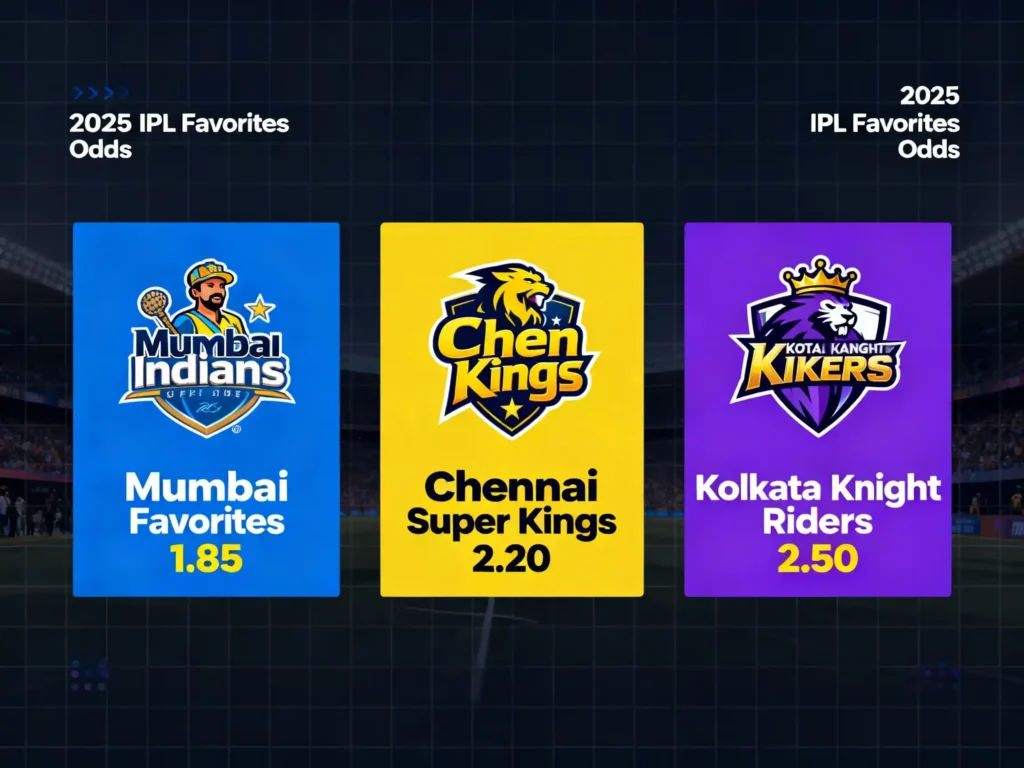
Current Favorites and Betting Lines
Understanding your favourites helps identify valuable betting opportunities.
Value Betting Strategy: Focus on mid-range odds (3.0-5.0) where Gujarat Titans, Punjab Kings, and Delhi Capitals offer better risk-reward than heavy favourites. Heavy favourites (MI, CSK) have odds insufficient for long-term profitability despite higher win probability.
IPL 2025 favorite teams and betting odds – Mumbai Indians, CSK, KKR
Pitch and Weather Analysis: Your Secret Competitive Advantage
Understanding Pitch Behavior
Pitch conditions dramatically influence match outcomes and betting opportunities.
Flat Pitches (Batting-Friendly)
- Venues: Wankhede (Mumbai), Arun Jaitley Stadium (Delhi), Narendra Modi Stadium (Ahmedabad)
- Characteristics: Even bounce, minimal deterioration, ball comes on bat easily
- Betting Strategy: Back over-under totals on the higher side (160+ runs). Back batsman-focused props (top batsman, 50+ runs). Avoid back bowling-dependent bets
Green Pitches (Bowler-Friendly)
- Venues: Dharamshala, Rajiv Gandhi International Stadium
- Characteristics: Movement off the ball, uneven bounce, ball swings and seams
- Betting Strategy: Back under on run totals. Favour top bowler markets. Consider laying strong batting teams at short odds
Turning Pitches (Spinner-Friendly)
- Venues: Chennai (Chepauk), Kolkata (Eden Gardens in later IPL stages)
- Characteristics: Rough patches deteriorate, rapid spin from day 1, uneven bounce
- Betting Strategy: Back bowling teams, especially with quality spinners. Target spinner performance props. Consider team combinations with strong spin attacks
Cricket pitch analysis for betting strategy, including weather and ground conditions
Weather Impact on Betting
Dew Factor – Evening matches in T20 leagues often feature heavy dew affecting ball behaviour.
- Impact: Chasing teams gain advantage, bowlers lose grip, and the ball skids through to the boundary.
- Strategy: Back chasing teams at improved odds after wickets fall. Favor batsman-focused markets over bowling markets
Rain Interruptions – Weather delays affect total overs and run rates.
- Impact: Shortened matches reduce expected totals and swing probabilities
- Strategy: If rain seems likely, shift toward lower run total bets. Use in-play betting to adjust as match conditions evolve
Wind Conditions – Affects ball movement and player comfort.
- Cross-wind: Increases swing bowling effectiveness
- Strategy: Favor teams with quality swing bowlers when strong crosswind is forecast

Cricket Match Prediction: Building Your Analysis Framework
Pre-Match Research Checklist
Successful cricket betting begins with comprehensive research before the match starts.
Team Form Analysis
- Review last 5-10 matches: Recent performance matters more than season records
- Analyze home vs. away performance: Teams often perform differently at home venues
- Check head-to-head records: Historical matchups reveal patterns and psychological advantages
Player Condition Assessment
- Monitor injury reports: Key players’ absences dramatically shift odds
- Analyze recent form: Players in hot streaks outperform their season averages
- Identify key matchups: Bowlers with specific advantages against batsmen create betting edges
Venue-Specific Factors
- Study ground dimensions: Short boundaries favor aggressive batsmen; large outfields suit bowlers
- Analyze boundary dimensions: Asymmetrical grounds affect scoring patterns
- Review weather forecasts: Check 3-5 days before match for accurate predictions
Toss Impact
- At certain venues, batting first or chasing provides significant advantages
- CSK prefers batting first at Chepauk; SRH often chases successfully at Hyderabad
- Use historical toss-win percentages by venue to identify value
Cricket match prediction analysis with team statistics and head-to-head data
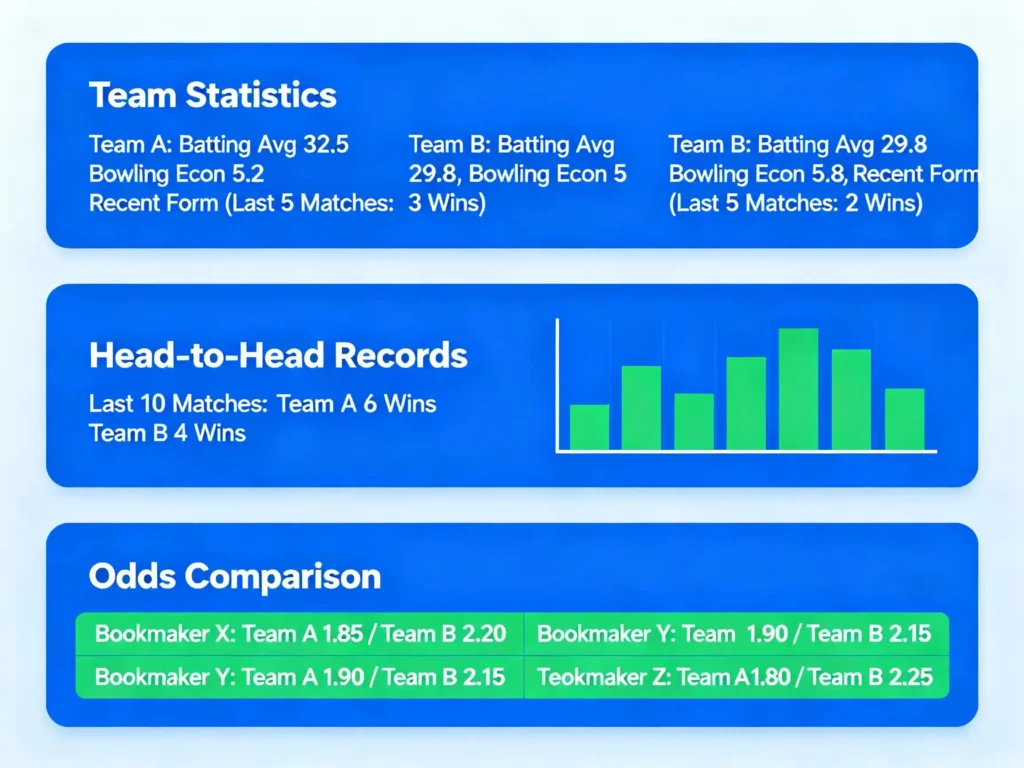
Key Metrics for Match Predictions
Powerplay Performance – The first 6 overs set the match tone; teams excelling in powerplay often win.
Middle Overs Control – Overs 7-15 determine momentum and final totals.
- Monitor run rates during middle overs
- Identify momentum shifts; betting against overreacted market
Death Bowling Strength – Final overs (16-20) often determine outcomes.
- Teams with explosive finishers (Bumrah and Chahal finishes) offer betting value
- Back teams with death-bowling specialists when odds reflect general performance
Run Rate Acceleration – How quickly teams can score under pressure.
- Teams maintaining required run rates despite wickets show betting value
- Betting against teams struggling with run rates offers confirmation opportunities
Building a Prediction Model
Professional bettors develop systematic prediction models integrating multiple variables.
Step 1: Team Strength Rating – Assign numerical ratings to each team (1-10) based on form, squad quality, and venue suitability.
Step 2: Venue Adjustment – Modify team ratings based on ground conditions (e.g., MI at Wankhede +0.5; KKR at small grounds +0.3).
Step 3: Key Player Impact – Adjust for star player absence (Bumrah out for MI = -1.0, top batsman unavailable = -0.5).
Step 4: Toss Analysis – Add/subtract based on venue toss history and team preferences.
Step 5: Convert to Probability – Calculate winning probability as a percentage (e.g., 65% = 1.54 odds).
Step 6: Compare to Bookmaker Odds – If your 65% probability reflects 1.70 odds at a bookmaker (58%), it’s a value bet.
Value Betting: Finding Edges in IPL Odds
Value betting separates professional bettors from casual punters.
Definition: Wagering when calculated probability exceeds the bookmaker’s implied probability.
Example:
- You assess Gujarat Titans’ 60% win probability in a match
- Bookmakers offer 2.00 odds (50% implied probability)
- Betting at 2.00 when you calculate 60% probability = +EV bet (positive expected value)
- Over 100 similar bets at +EV, you profit despite losing some individual wagers
Finding Value in IPL:
- Back underdogs (3.0+ odds) when home advantage, favorable conditions, or recent form justify higher probability
- Lay heavy favorites (1.5 or less) when they play at hostile venues or lack key players
- Focus on mid-tier odds (2.5-4.0) where most consistent value exists rather than chase long-shot parlays
Cricket Betting Markets: Comprehensive Overview
Match Winner (1X2)
The simplest market: predict the outright winner.
Pros: Straightforward betting, highest odds stability, easiest to track
Cons: Lower odds availability than other markets, requires overall match mastery
Strategy: Use the match winner as the primary market only when you have a strong information edge. Most professional bettors prefer alternative markets.
Over/Under Totals
Predict whether combined or individual innings runs exceed/fall short of the bookmaker’s line (typically 160-170 for 20-over T20).
Cricket-Specific Over/Under Markets:
- Match totals (both teams combined)
- Individual innings totals (batting first team total)
- Boundary counts (sixes and fours in match)
- Wicket totals (how many wickets will fall)
Strategy: Analyse pitch and weather; if supporting bowlers, back under. Flat pitches justify over bets. Compare multiple bookmakers for the best lines.
Top Batsman/Bowler
Predict which player scores the most runs (batsman) or takes the most wickets (bowler).
Factors to Consider:
- Recent form and consistency
- Playing position (openers get more balls; bowlers get more overs)
- Head-to-head matchup (bowlers’ strengths against opposing batting order)
Strategy: Back batsmen with momentum and upcoming opposition bowling weaknesses. Favour bowlers facing batting-weak opposition.
Player Performance Props
Specific player outcomes: 30+ runs, 2+ wickets, boundary in over, etc.
Value Opportunities: Props on emerging players often have superior odds compared to their actual performance probability.
Powerplay Markets
Predict powerplay (first 6 overs) runs or wickets.
Strategy: Powerplay markets provide early betting opportunities and often feature sharp bettors. Lines adjust quickly, reducing value after the first hour.
Live/In-Play Betting Markets
Most dynamic market with constant odds updates during the match.
Available Markets During Match:
- The next wicket over (which over will produce next wicket)
- Runs in next over
- Session runs (runs in 6-over segments)
- Remaining overs prediction
Live Betting Strategy: Real-Time Tactics for Maximum Profit
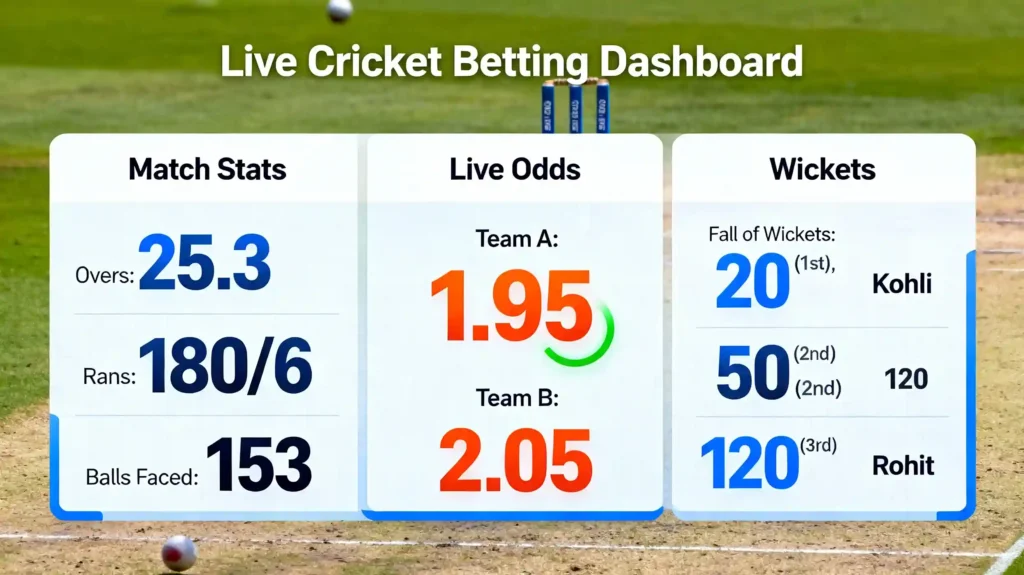
Live cricket betting dashboard with real-time odds and match statistics
Why Live Betting Dominates Cricket
Live betting accounts for 60-70% of total cricket betting volume during IPL season.
Advantages:
- Better odds frequently available than pre-match
- Real-time information informs decisions unavailable pre-match
- Momentum shifts create mispricings bettors can exploit
- Cash-out features enable flexible position management
Reading Match Momentum in Real-Time
Identifying Momentum Swings Before the Market Reacts:
Partnership Building – When established batsmen and bowlers are in sync, betting against that partnership becomes risky. If their strike rate gradually increases despite losing wickets, momentum is building.
Wicket Timing – Loss of a key player doesn’t immediately guarantee collapse. Teams with depth (all-rounders available) often recover. Experienced bettors wait 1-2 overs before heavy laying.
Overreaction to Boundaries – Single boundaries sometimes cause sharp odds movements. Professional bettors recognise overreactions, resisting the impulse to chase movement.
Example:
- The batsman hits two consecutive sixes (4 runs scored)
- Odds shift dramatically: team goes from 2.50 to 2.20 (market overreacting)
- Professional analysis shows the match is still under control; laying team at 2.20 offers value
Powerplay Phase Strategy
First 6 Overs Dynamics:
- Batsmen are aggressive, seeking early momentum
- Bowlers often lack rhythm in early overs
- Powerplay runs directly correlate with final totals
Live Betting Actions:
- If powerplay wickets fall without disrupting run rate, back batting team at available odds
- If powerplay restrictions (boundaries, wickets) slow scoring, lay batting team at reduced odds
- Back runs in next over when bowlers are tired or batsmen are fluent
Middle Overs (7-15) Momentum Trading
Middle Overs Characteristics:
- Momentum reversal periods (partnerships break, bowlers find rhythm)
- Often features lower market interest (fewer bets), creating odds value
- Small wickets often trigger disproportionate odds movements
Professional Strategy:
- Monitor strike rotation and run rates
- When batting team loses key wicket (top-3 batsman, accelerator), odds might spike above true value
- Lay batting team at spiked odds, backing them to recover after new batsman settles
Example:
- CSK loses MS Dhoni in 14th over (semi-new batsman with momentum)
- Odds shift: CSK from 1.50 to 2.80 (market panics)
- Professional assessment: new batsman will likely settle; CSK still wins despite losing Dhoni
- Lay Chennai at 2.80, profiting when odds return to 1.80-2.00
Death Overs (16-20) Strategy
Death Overs Volatility:
- Explosive scoring possible (15-20 runs per over)
- Also prone to collapses (4-5 runs per over in defensive scenarios)
- Odds swings most dramatic in final overs
Live Betting Approach:
- Back batting team if setting batsman is still there with wickets remaining
- Lay bowling team if they’re defending weak total under 140 with 3+ overs remaining
- Focus on specific over betting (runs in 17th over, 18th over) where patterns emerge
Cash-Out Strategy
Most modern betting platforms offer cash-out features, enabling profit-locking or loss-minimisation.
When to Cash Out:
- You backed the team at 2.50; odds are now 1.70: cash out 70% of the position to reduce exposure
- Injury to a key player makes your bet less certain: cash out before odds collapse further
- Opposition team on momentum surge; odds deteriorating: secure partial profit
Cash-Out Discipline:
- Only cash-out when mathematical edge no longer exists
- Don’t cash-out prematurely during momentum swings that will reverse
Risk Management: Protecting Your Betting Capital
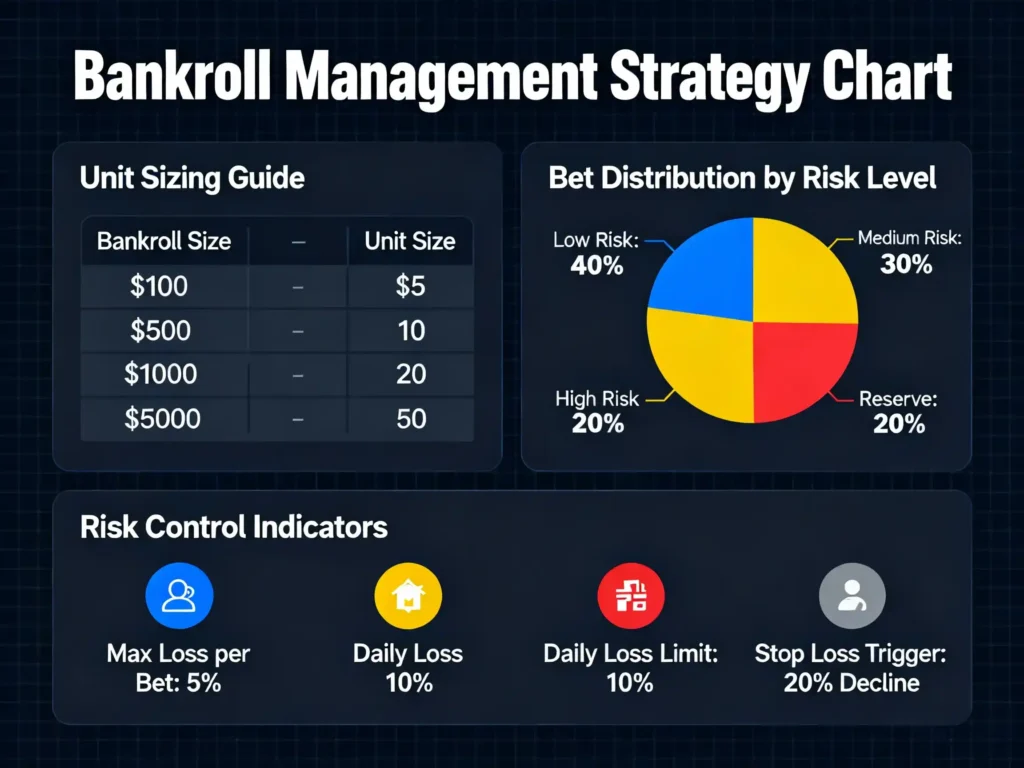
Bankroll Management Framework
Bankroll management strategy and unit sizing for cricket betting
Bankroll management is THE most critical factor determining long-term betting success.
Step 1: Define Your Total Bankroll
Separate betting funds from essential expenses.
- Total bankroll: ₹50,000 (dedicated betting capital only)
- Monthly allocation: ₹10,000 (safe monthly limit)
- Daily limit: ₹500 (prevents emotional over-betting)
Step 2: Establish Unit Size
Unit size = percentage of bankroll wagered per bet.
| Risk Tolerance | Unit Size | Example (₹50,000 Bankroll) |
|---|---|---|
| Conservative | 1% | ₹500 per bet |
| Moderate | 2-3% | ₹1,000-₹1,500 per bet |
| Aggressive | 4-5% | ₹2,000-₹2,500 per bet |
Professional Recommendation: Start with 2% units (₹1,000), maintaining consistency until the bankroll grows to ₹100,000+.
Step 3: Implement Staking Strategy
Flat Staking (Beginner-Friendly)
- Wager same unit size on every bet regardless of odds or confidence
- Reduces variance, extends bankroll longevity
- Example: Bet ₹1,000 on MI at 1.80, next day ₹1,000 on CSK at 2.20
Variable Staking (Intermediate)
| Confidence Level | Unit Multiplier | Example Bet |
|---|---|---|
| Low Confidence | 1.0x | ₹1,000 |
| Moderate Confidence | 1.5x | ₹1,500 |
| High Confidence | 2.0x | ₹2,000 |
Kelly Criterion (Advanced)
- Mathematical formula maximizing long-term capital growth: f* = (bp – q) / b
- f* = fraction of bankroll to bet, b = odds, p = win probability, q = loss probability
- Example: 60% win probability, 2.00 odds → f* = (1.00 × 0.60 – 0.40) / 1.00 = 20% of bankroll
- Kelly Criterion is aggressive; many professionals use “half Kelly” (10% bankroll per bet)
Avoiding Common Bankroll Destruction Mistakes
Chasing Losses
- ❌ WORST MISTAKE: After losing ₹2,000, immediately betting ₹5,000 to recover
- ✅ CORRECT APPROACH: Accept loss, maintain unit size, continue strategy
- Why it fails: Emotional decisions eliminate analytical edge; losses compound
Over-Concentrating Bets
- ❌ Betting entire bankroll on single match
- ✅ Diversify across 3-5 matches daily; spread risk
- Principle: Even 70% accurate bets occasionally lose; concentration risks ruin entire bankrolls.
Increasing Bets During Winning Streaks
- ❌ After winning 5 bets in a row, increasing unit size to ₹3,000
- ✅ Maintain disciplined unit size; gradually increase only after bankroll grows 20%+
- Why: Winning streaks end; protected bankroll survives dry spells
Ignoring Bet Tracking
- ❌ Placing bets without recording details (amount, odds, result, reasoning)
- ✅ Maintain detailed betting journal: date, match, odds, stake, result
- Analysis: Monthly reviews identify profitable markets/strategies versus losing ones
Risk Management Rules for Professional Bettors
Rule 1: Never Risk More Than 5% on Single Bet
Rule 2: Maximum 10% Loss per Day
Rule 3: Diversify Betting Portfolio
- Spread bets across different matches, markets, and bet types
- Don’t concentrate on single team or match outcome
Rule 4: Reserve 20% for Opportunistic Bets
- Keep emergency capital for high-value opportunities identified during the season.
Rule 5: Monthly Profit Targets and Withdrawal
- Set realistic targets (5-10% monthly return)
- Withdraw profits regularly rather than reinvesting all gains
Common Mistakes Professional Bettors Avoid
- Betting Without Research – Guessing instead of analysing leads to predictable losses.
- Ignoring Venue and Weather Conditions – Pitch and weather are primary outcome drivers; ignoring them eliminates critical edges.
- Overvaluing Favourites – Popular teams often have inflated odds insufficient for long-term profit.
- Emotional Betting on Favourite Teams – Betting on your favourite team rather than value bets destroys bankrolls.
- Reactive Live Betting – Betting impulsively after boundaries/wickets without an analytical framework.
- Ignoring Line Movements – Failing to recognise when odds move due to sharp money (professional bettors) versus casual action.
- Not Tracking Performance – Without detailed records, identifying what works becomes impossible.
- Betting During Emotional States – Betting after losses, during intoxication, or in high-stress situations typically results in poor decisions.
IPL 2025 Betting Calendar: Seasonal Strategy Optimization
Pre-Season Phase (February-March)
Strategy Focus: Build knowledge base, identify value in outright winner markets.
Key Activities:
- Analyze team changes after IPL auction
- Research new foreign signings and their track records
- Identify value in long-term tournament bets (MI, GT winner bets)
- Begin pitch analysis for all venues
Best Markets: Outright winner, top 4 finish, top 6 finish
Regular Season (April-May)
Strategy Focus: identify form trends, exploit momentum through multiple matches.
Key Activities:
- Track team performance over 5-10 matches, identifying improving/declining trends
- Adjust opponent analysis weekly based on recent performances
- Focus on live betting as patterns become evident
- Identify consistent value markets (specific teams, venues, bet types)
Best Markets: Match winner, over/under, live betting, props
Playoffs (May End)
Strategy Focus: Volatility increases; capitalise on emotional betting distortions.
Key Activities:
- Pressure situations create mispricings; identify undervalued teams under pressure
- Live betting dominates; momentum swings rapidly.
- Avoid multi-team parlays; stick to single-match analysis
Best Markets: Live betting, specific playoff match analysis
FAQs: Cricket Betting Strategies
Q1: What’s the best cricket betting strategy for beginners?
Start with match winner and over/under bets on major matches. Focus on research before live betting. Use a 2% bankroll unit size. Avoid parlays initially.
Q2: How do I identify value bets in cricket?
Calculate your win probability estimate and compare it to the bookmaker’s implied probability. If you assess 55% but odds show 50%, it’s value. Repeat 100+ times for positive expected value.
Q3: Should I bet on favourites or underdogs?
Q4: What’s the best way to manage live betting?
Watch closely, and identify momentum shifts before the market does. Use cash-out strategically. Maintain unit size discipline even in volatile markets.
Q5: How much should I bet on a single wager?
Professional standard: 1-5% of bankroll maximum. For a ₹50,000 bankroll, the maximum is ₹2,500 per bet (5%). Most use 2% (₹1,000).
Q6: Can I make consistent profit from cricket betting?
Yes, with disciplined strategy, research, and bankroll management. Professional bettors achieve 52-60% long-term accuracy. Your 2% edge × 100 bets = 2% profit.
Q7: How often should I place bets?
Quality over quantity. 3-5 well-researched bets daily are better than 20 rushed bets. Daily betting isn’t necessary; focus on matches with a research edge.
Q8: Should I use bookmaker bonuses?
Yes, but read the terms carefully. Bonuses typically require 5-10x wagering before withdrawal. Calculate actual value before claiming.